In a nutshell
- ⚡ Discovery: A vast polar electrojet links Jupiter’s auroras to deep weather, with pulses driving chemical and thermal cascades that form mushballs and shift ammonia—revealing a hidden planetary “power grid.”
- 🛰️ Evidence chain: Coordinated data from Juno, Hubble, and JWST show auroral power spikes, H3+ heating, and subsequent NH3 drops; bursts align with Io’s 1.77-day orbit, tightening the magnetosphere-to-clouds connection.
- 🌪️ Why it matters: The coupling helps explain Jupiter’s excess energy budget, reframes belts and zones as responsive to space weather, and hints at impacts on zonal jets, the Great Red Spot, and cloud chemistry.
- 🔎 Methods: Cross-correlation of auroral timing with microwave opacity from Juno MWR provides the “smoking gun,” indicating phase-lagged weather changes after polar energy injections.
- 🚀 What’s next: New Juno passes will test predicted phase lags; JUICE will map magnetic coupling, while integrated magnetosphere–ionosphere–atmosphere models probe how these pulses might also shape exoplanet climates.
Jupiter has surprised astronomers again. The gas giant’s newest revelation is not a pretty picture or a passing storm, but a hidden engine powering both its weather and its lights. A fresh analysis of signals from multiple spacecraft points to a previously uncharted electrical circuit that links the planet’s roaring auroras with deep atmospheric chemistry. Think of it as a planetary power grid. Pulsing. Planet-spanning. And consequential. What looked like random flickers above the poles now appears to be steering material and heat thousands of kilometres below, rewriting how scientists explain the belts, bands, and the planet’s puzzling energy surplus. That’s why the community is stunned.
What Exactly Did Astronomers Find?
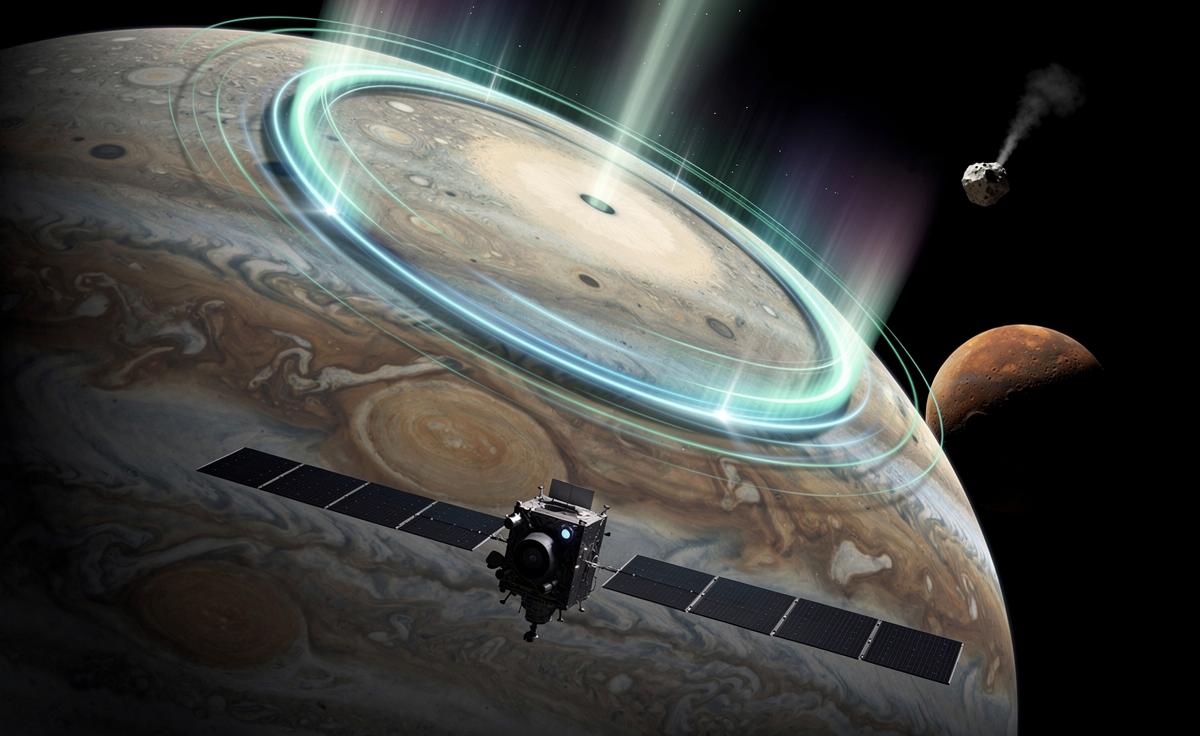
At the heart of the announcement is a vast, high-altitude electrojet encircling Jupiter’s polar regions. This current system, driven by the planet’s enormous magnetosphere and the volcanic moon Io, doesn’t just make auroras glow; it periodically compresses the upper atmosphere, triggering chemical and thermal cascades that reach the weather layer. This is the strongest evidence yet that Jupiter’s auroral power directly shapes its deep meteorology. The result? Pulses in the electrojet correlate with windows when ammonia-water droplets grow into dense “mushballs,” hail-like pellets that plunge, melt, and re-evaporate, redistributing heat and depleting ammonia in the belts where probes have long measured puzzling shortages.
The signature is global, but the timing is precise. Bursts repeat in sync with Io’s 1.77-day orbit and with changes in H3+ infrared emissions. Short, sharp, then quiet. Storm tracks appear to intensify days after the strongest pulses, suggesting a causal chain between high-latitude energy deposition and mid-latitude weather. In essence, Jupiter’s skies are wired: a circuit from magnetosphere to clouds, from particles to precipitation, matching decades of hints but finally assembling a coherent physical picture.
How the Discovery Was Made
The breakthrough required a jigsaw of observations. NASA’s Juno spacecraft provided the backbone: microwave radiometry to map ammonia deep below the clouds, ultraviolet and infrared instruments to watch the aurora, and a magnetometer to track currents. Complementary snapshots from the Hubble Space Telescope in ultraviolet and the James Webb Space Telescope in infrared stitched in the missing time and wavelength coverage. Researchers then aligned the datasets by Jupiter System III longitude and Io’s phase, applying cross-correlation techniques typically used in helioseismology. Patterns emerged. Clean. Repeating. And too consistent to ignore.
| Instrument | Band/Mode | Primary Signal | Key Clue |
|---|---|---|---|
| Juno MWR | Microwave (1–50 cm) | Ammonia depth profiles | Step-like NH3 depletions after auroral surges |
| Juno-UVS / JIRAM | UV / IR imaging | Auroral brightness pulses | Electrojet timing, energy input |
| HST | Far-UV | Precipitating electron flux | Polar power variations |
| JWST | NIRSpec / MIRI | H3+, hydrocarbons | Thermospheric heating, chemistry links |
The alignment of auroral power spikes with subsequent subsurface ammonia changes is the smoking gun. It rules out coincidental weather variability and supports a dynamic coupling: energy pours in at the poles, travels along magnetic field lines, drives ionospheric winds, and modulates condensation and hail formation far below.
Why It Redraws Our Picture of Jupiter
Jupiter’s atmosphere has long looked overpowered, radiating more heat than sunlight can explain. The new electrojet–mushball connection supplies a missing piece. By throttling condensation and latent heat release, the polar current acts like a planetary thermostat, nudging the balance in real time. That reframes the belts and zones: not just passive bands, but responsive lanes that brighten or fade with pulses from the poles. Weather is no longer only a product of deep convection—it is, at times, a reaction to space weather. That is a profound shift.
The implications ripple outward. Models of zonal jets will need to incorporate variable ionospheric drag and energy deposition; magnetic anomalies like the Great Blue Spot may influence where and when pulses couple strongest. Even the resilience of the Great Red Spot gains a new angle, with high-altitude heating conditions potentially altering the vortex’s energy diet. For exoplanets—hot Jupiters roasted by stellar winds—the lesson is bolder still: magnetospheric forcing might sculpt clouds, chemistry, and climate in ways telescopes can detect from light-years away.
The Next Questions Scientists Will Chase
Big answers invite sharper questions. How deep does the auroral influence truly reach—hundreds of kilometres, or thousands? What sets the cadence of the strongest pulses, and why do some cycles fail to produce mushball cascades? Researchers will test predictions in the next Juno perijoves by watching for phase-lagged changes in microwave opacity, and by tracing how hydrocarbon signatures evolve in JWST spectra after auroral storms. If the chain is causal, the timing should repeat like a drumbeat.
Upcoming missions add oomph. ESA’s JUICE will probe the Jovian system’s magnetic environment near Ganymede, while continued Hubble and ground-based radio campaigns will keep real-time tabs on the poles. Laboratory work on ammonia-water hail will tighten microphysics. Finally, global circulation models that couple magnetosphere, ionosphere, and weather will pit the hypothesis against nature. Success means a unified Jupiter, from spark to storm. Failure would be just as instructive, forcing new physics into the frame.
Jupiter, once the archetype of orderly belts and timeless ovals, now looks wired, twitchy, and exquisitely connected from aurora to atmosphere. That is a thrilling, humbling revelation for anyone who has ever stared at its bands through a small telescope and wondered what drives them. We may be looking at the blueprint for giant-planet climates across the galaxy. As the data keep flowing and models sharpen, what hidden linkage will the next pulse from Jupiter expose—and how might it change the way we read the weather on worlds far beyond our own?
Did you like it?4.5/5 (22)