In a nutshell
- 🌠 November features the Leonids, both Taurids, and rare Alpha Monocerotids, each with distinct character: fast needle-like streaks versus slow, bright fireballs; typical ZHRs range from 5–20 under dark skies, with speeds from ~27 to ~71 km/s.
- 🧪 The “hidden message” is scientific, not mystical: meteors are data about stream density, composition, and origins—think the sprawling Taurid Complex and the Leonids’ 33-year outburst cycle—revealing how the Solar System is built.
- 🇬🇧 UK viewers rarely get ZHR “best case” counts; geometry, radiant altitude, moonlight, and light pollution reduce totals. Aim later for Leonids, earlier for Taurids, and look ~40° from the radiant for longer trails.
- 📝 Turn watching into contribution: log time, direction, colour, and speed; use cameras and meteor scatter radio to catch faint events; comfort and patience (warm layers, dark sites) improve results more than any gadget.
- 🔭 Big takeaway: patterns in November’s meteors connect comet history to present-day preparedness; by observing steadily, we decode a long-running celestial ledger rather than chase one-night fireworks.
Every November the headlines promise fireworks in the firmament, then quietly move on when the sky delivers subtlety instead of spectacle. The truth is more interesting. The month is a palimpsest of dusty trails—ancient comet crumbs—that Earth ploughs through at predictable times. Some nights whisper. Others crackle. And hidden within those streaks lies a story about our past and our preparedness. The meteor shower isn’t a single event. It’s a sequence, a chorus with soloists. If you’re looking for a message, listen to the rhythms of frequency, speed, and brightness. The sky is telling us how the Solar System is built, and how fragile our plans can be.
The Showers You Think You Know
Say “November meteors” and most people reply with “Leonids,” remembering tales of storms so intense they looked like celestial rain. Today, the Leonids usually produce a modest display—often 10–20 meteors per hour under dark skies—punctuated every 33 years or so by rich outbursts from the debris of Comet Tempel–Tuttle. But there’s a twist. The slower, sprawling Taurids, both Southern and Northern branches, often steal the show with fat, patient fireballs that seem to drift across the sky. They feel theatrical. They’re also scientifically loud, hinting at a complex swarm of debris linked to Comet 2P/Encke and a broader Taurid Complex of fragments.
Here’s a simple guide to November’s usual suspects. Note that counts vary with sky darkness, radiant altitude, and year-to-year clumping of dust.
| Shower | Typical Peak | ZHR (dark sky) | Speed (km/s) | Radiant |
|---|---|---|---|---|
| Southern Taurids | Late Oct–early Nov | 5–10 | ~27 | Taurus |
| Northern Taurids | Early–mid Nov | 5–10 | ~29 | Taurus |
| Leonids | Mid Nov | 10–20 (variable) | ~71 | Leo |
| Alpha Monocerotids | Late Nov | Rare outbursts | ~65 | Monoceros |
Don’t expect fireworks every minute; expect character. The Taurids bring brightness. The Leonids bring speed. Together, they write November’s plot in brief, incandescent sentences.
The Hidden Message In The Meteors
Meteor showers are not omens. They’re data. That’s the hidden message—romance wrapped around rigorous clues. Each streak is a grain striking air at tens of kilometres per second, vaporising and ionising, tracing a line that encodes velocity, direction, and composition. The Taurid Complex whispers about a shattered, ancient progenitor; its occasional run of fireballs suggests larger fragments still haunt the stream. The fast, needle-like Leonids remind us that comets refresh their trails, and that rare “storm years” aren’t myths but mechanics: Earth intersects denser filaments when the geometry, and the comet’s 33-year clock, align.
There’s a literal message too. Radio enthusiasts exploit meteor scatter: VHF signals ping off ionised trails, carrying bursts of communication beyond the horizon for a second or two. When a meteor flares, radios briefly sing. In this sense, the sky transmits. Yet the deeper broadcast is geological. November’s meteors underline our collision-prone neighbourhood and the need to track small bodies with boring precision, not breathless prophecy. Watch long enough and patterns emerge: swarms, resonances, outliers. The archive of the night becomes a ledger of the Solar System, updated annually, audited by anyone with patience and a notebook.
What The Numbers Don’t Tell Nightwatchers In The UK
Forecasts quote ZHR, a calibrated “best case” from a perfect sky with the radiant overhead. The UK seldom gets that. Moist air, low radiant angles for some showers, and light pollution shave counts. What looks like underperformance is often geometry. From British latitudes, the Leonids’ radiant climbs after midnight; the later you stay out, the better your odds. The Taurids ride high earlier in the evening, which is why those stately, slow fireballs pop up even during tea time commutes.
There’s psychology at play. Bright meteors imprint on memory; faint ones vanish between glances. Short sessions mislead. Watch for an hour, or two, and the rhythm surfaces—lulls, then flurries, then a sudden gasp from a green fragmenting fireball. Moonlight matters. So does where you look: about 40 degrees away from the radiant often yields better trails with longer arcs. Cameras exaggerate activity because sensors drink in faint streaks your eyes will miss. If a forecast promised 15 per hour and you spotted five, it doesn’t mean the shower failed; it means the conditions edited the script. Plan for darkness, patience, and realistic expectations.
How To Read The Sky And Make It Count
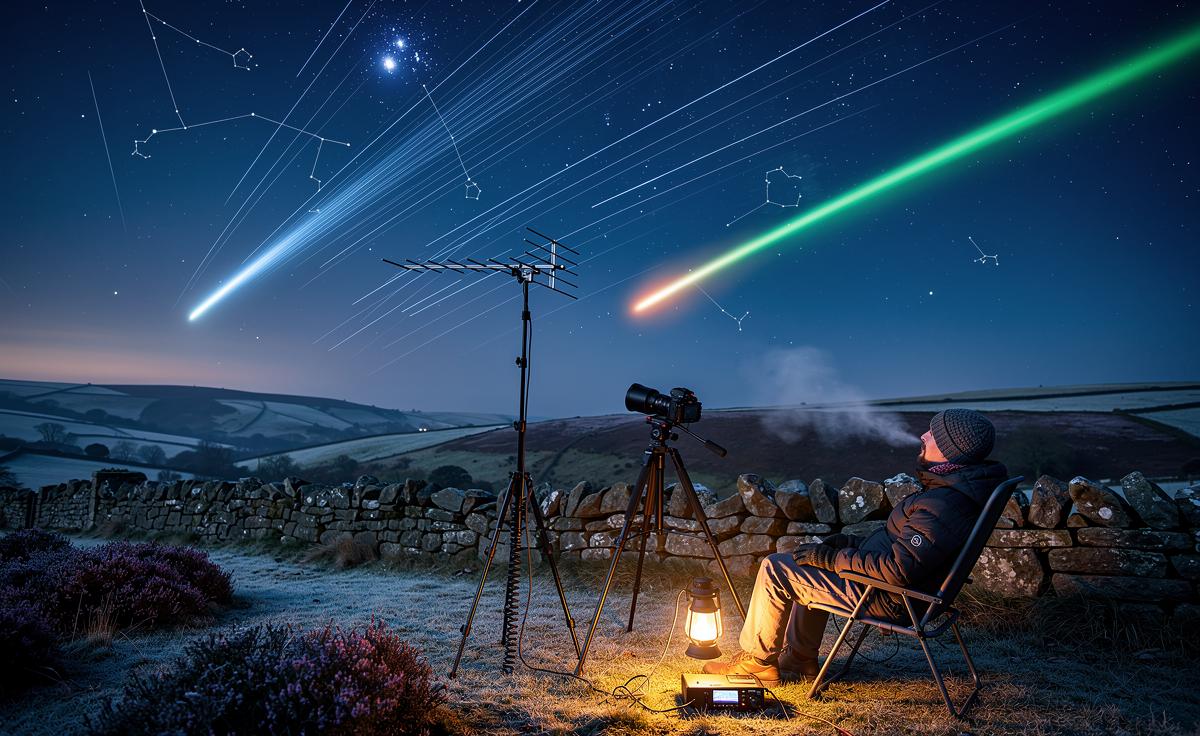
Turn the shower into a story you can share. Note the time, direction, colour, and length of each meteor. Was it swift and needle-thin like a Leonid? Or a lazy, flaring Taurid with a terminal burst? These notes feed citizen-science projects that refine our knowledge of stream density and fragment sizes. Pair visual watching with a low-cost radio setup to hear the “pings” of meteor scatter, or set up a wide-field camera to catch the faint majority. Every observation, even “only four in an hour,” is a pixel in a much larger picture.
Think safety, and sanity. Warm layers, a reclining chair, and a shield from wind extend your session, which improves the statistics more than any gadget. Pick moonless windows and rural sites where practical; if not, shade stray light and let your eyes adapt. Leave fireworks at home. Bring curiosity instead. The hidden message you’ll decode isn’t mystical. It’s procedural: the Universe rewards attention. What we measure, we protect. What we share, we remember.
November’s meteors won’t always stage a blockbuster, but they always carry meaning—about the comets that shed them, the debris that lights our sky, and the vigilance that keeps our world informed. Listen to the patterns, log what you see, and you’ll discover a conversation stretching across centuries. The sky is offering a lesson in patience and pattern recognition, disguised as a light show. When you next step outside on a crisp, dark night, what message will you choose to hear—and what evidence will you bring back?
Did you like it?4.4/5 (20)